

If your dog drools, whines or paces as soon as the car door opens, CBD is worth a closer look. Several controlled studies in dogs have measured stress during real car journeys, and some of them found lower stress hormone levels after CBD than after a placebo. The results are modest and differ from dog to dog, which is why CBD works best as one part of a plan that also includes gradual car training and your vet’s input. This guide covers what the studies tested, how to tell anxiety from motion sickness, how to choose a product, and how to use it safely. Our CBD products for pets are lab-tested and made for owners who want a clear starting point.
TL;DR
- A 2023 study found that a single dose of THC-free CBD given before a car trip lowered cortisol (a stress hormone) and changed behavior ratings compared with placebo.
- A 2024 study of daily CBD found smaller cortisol rises after car travel, and the authors suggest pairing CBD with behavior training.
- Car anxiety and motion sickness look alike. Sort out which one your dog has before you choose a product.
- Choose a THC-free pet product with a certificate of analysis, talk to your vet first, and watch for loose stools, sedation and medication interactions.
- Desensitization, a cool car and short practice trips do the heavy lifting, and CBD can sit alongside them.
Table of Contents
- Is it anxiety or motion sickness?
- What the studies actually measured
- How to use CBD for a car-anxious dog
- Side effects and when to call your vet
- What about fireworks and other noise fears?
- A note on CBD and appetite
- Where our pet CBD fits
- FAQ
- Sources
Is it anxiety or motion sickness?
The two problems overlap, and the fix depends on which one you have. The Dodo describes car anxiety as generally behavioral and motion sickness as generally physiological, though motion sickness can lead to car anxiety over time. A dog that gets sick on a trip can start to dread the car itself.
Signs that point toward anxiety:
- Panting, whining or trembling before the engine even starts
- Reluctance to get near the car or jump in
- Lip licking, yawning and pacing
- Vomiting or diarrhea tied to stressful destinations such as the vet
Signs that point toward motion sickness:
- Drooling and nausea that build as the car moves
- Vomiting mainly on winding roads
- A dog that is fine sitting in a parked car
VCA Animal Hospitals notes that motion sickness is more common in younger dogs whose balance systems are still developing, and many puppies outgrow it by around one year. The same page explains that anti-nausea drugs treat motion sickness but not anxiety. In the same way, CBD is explored for calmer behavior and is not a nausea treatment. If your dog vomits on every trip, tell your vet so they can sort out the cause.
What the studies actually measured
Researchers have tested CBD in the car itself, which is rarer than you might expect for pet supplements. Here is what each study did and found.
A single dose before a trip (2023)
In a 2023 study in Frontiers in Veterinary Science, dogs received a single 4 mg/kg dose of THC-free CBD two hours before a car journey. Dogs on CBD were rated significantly less “sad” than placebo dogs, with a smaller drop in “relaxed” ratings, and had significantly lower serum cortisol. Effects varied by measure and test, so think of this as a measurable calming signal rather than a switch.
Daily dosing over months (2024)
A study in the Journal of Animal Science followed 19 dogs given 4 mg/kg of CBD daily during short, slow car trips. Cortisol, whining, lip licking and qualitative ratings showed significant reductions versus placebo at least at one time point. The cortisol benefit showed up in the early weeks of testing, and the authors concluded CBD is best used alongside behavior modification rather than on its own. That fits what trainers say about any calming aid: it creates room for learning, and the learning is what lasts.
CBD treats with calming ingredients (2025)
A 2025 crossover study of 54 dogs tested treats. The 2 mg/kg CBD treat combined with L-tryptophan and α-casozepine produced a significantly smaller cortisol increase after car travel than placebo. The authors described the effect as mild and noted that blood CBD levels varied a lot between individual dogs given the same dose. In practice, two dogs of the same weight can respond differently, so you learn your own dog’s response gradually.
What this means for you
Across these studies, the pattern is consistent: CBD was tested at specific, weight-based doses, in specific settings, and the best-supported benefit was a lower physiological stress response during travel. None of this makes it a replacement for training. It also means the product format matters, because the studies used defined doses of THC-free CBD, not a guess from a dropper.
How to use CBD for a car-anxious dog
Start with your vet. They know your dog’s weight, health history and any medications, and some medications interact with CBD. Cornell’s Riney Canine Health Center notes that CBD can affect liver enzymes involved in processing other drugs, which is the reason to review any current prescriptions before adding it.
Step 1: Pick a THC-free pet product
THC is a safety concern for dogs. A 2025 review in the Journal of Cannabis Research lists urinary incontinence, disorientation, a slow heart rate, twitching and delayed-onset signs as signs of THC toxicosis. Choose products made for pets, with THC-free CBD, and keep all human cannabis products and edibles out of your dog’s reach.
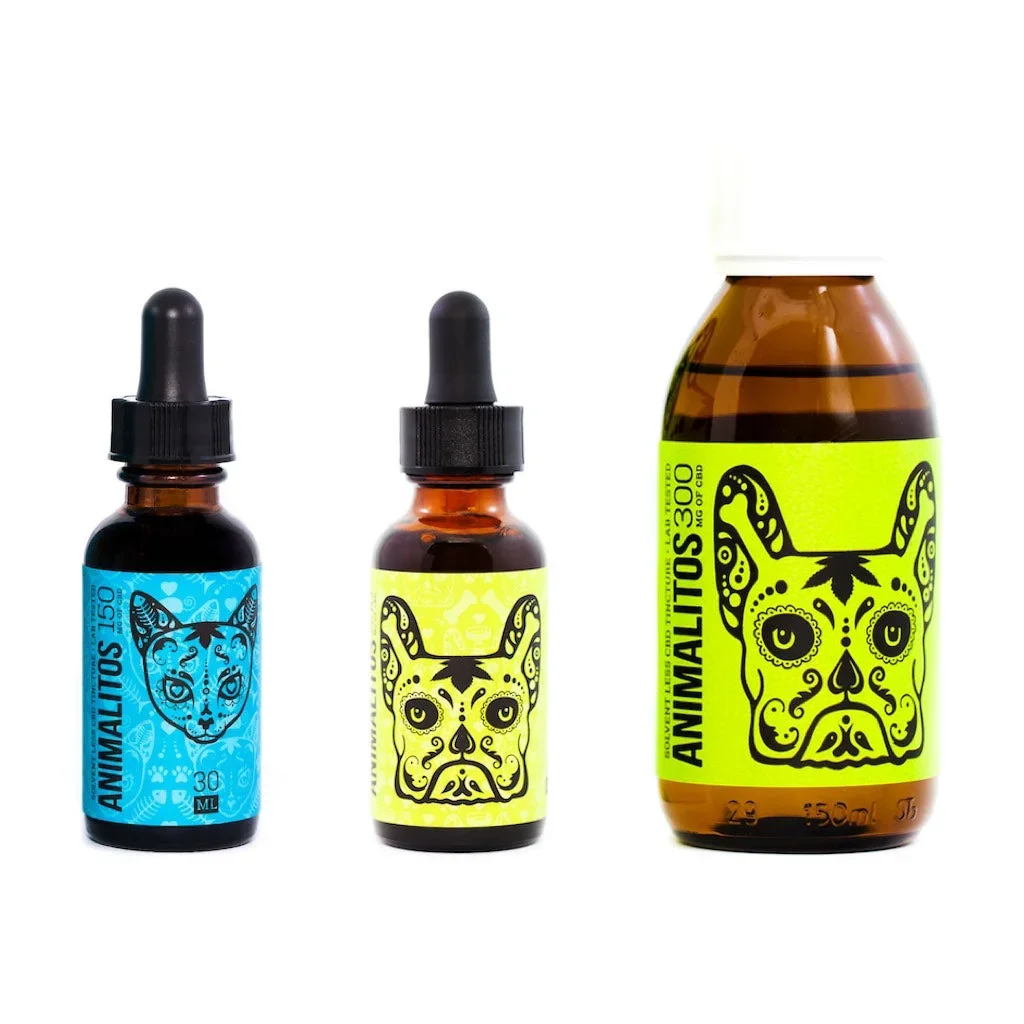
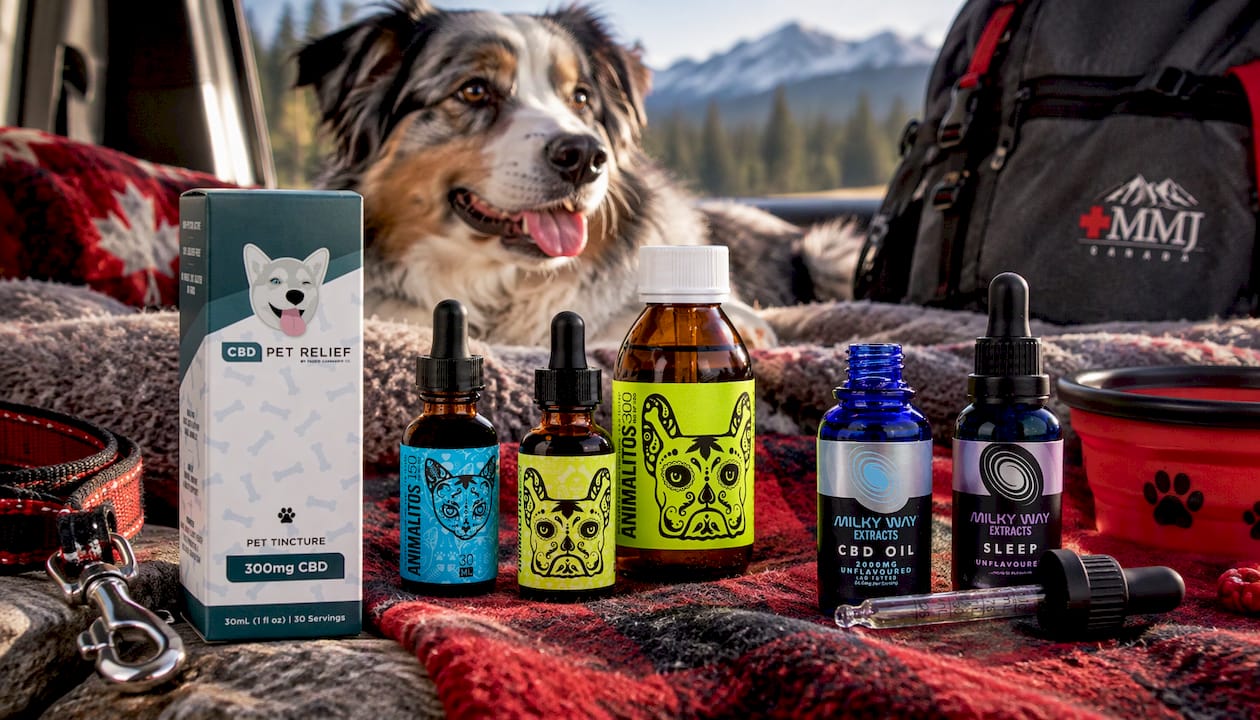
Our pet range includes the Faded Cannabis Co. CBD pet tinctures and the MOTA Animalitos CBD pet tincture, which comes in a 150 mg to 300 mg range. If your dog does better with a treat format, our guide to CBD soft chews for dogs covers dose and label checks.
Step 2: Read the label and the lab report
Product quality varies widely across the pet CBD market. A 2025 review reported that only 31% of tested CBD products were accurately labelled, and that a certificate of analysis is needed to learn a product’s exact composition. A certificate of analysis, or COA, is the lab report showing how much CBD, THC and contaminants a batch contains. A step-by-step guide to reading a COA for potency and safety shows which lines to check first: cannabinoid content, THC level and contaminant results.
Our products are lab-tested, so you start from a product with testing behind it. Compare the milligrams of CBD per dose on the label with the figure you and your vet decide on.
Step 3: Work out a dose with your vet
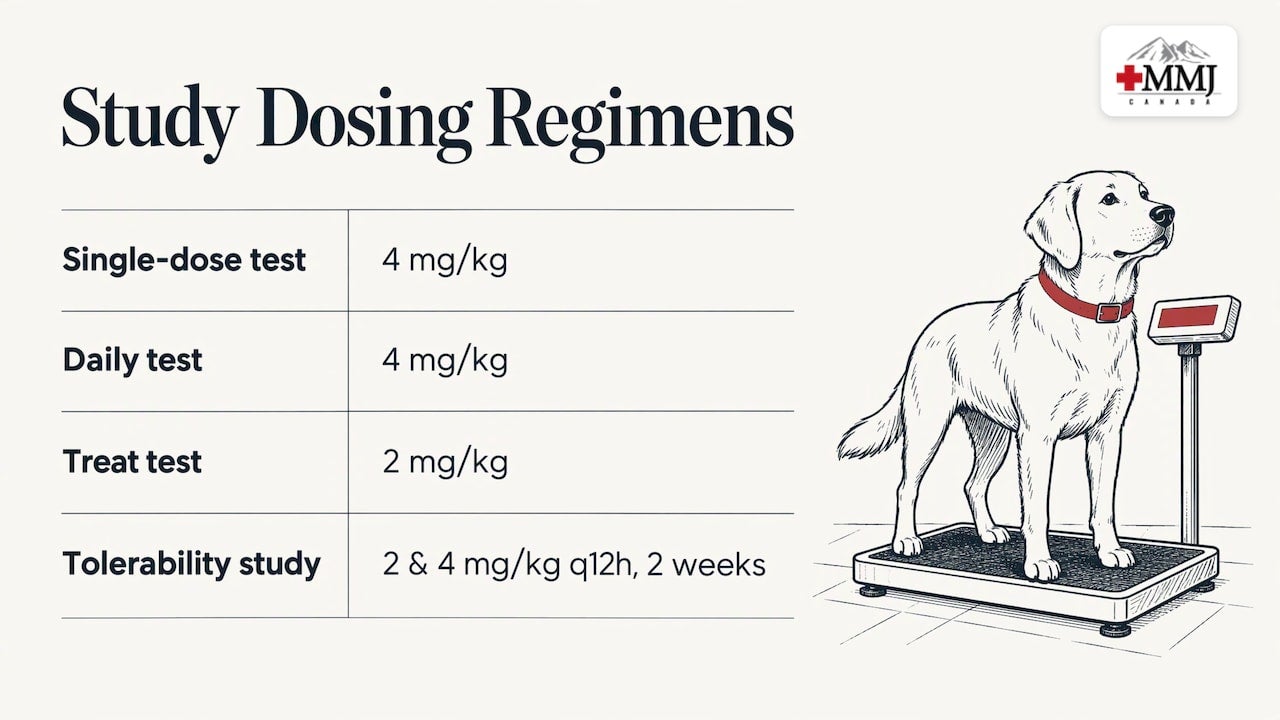
Studies dose by body weight, in milligrams per kilogram (1 kg is about 2.2 lb). The car studies above used 4 mg/kg for the single-dose and daily tests and 2 mg/kg for the treat. A 2024 tolerability study of 18 dogs found that 2 and 4 mg/kg of CBD-rich hemp every 12 hours for two weeks caused no adverse effects or behavior changes, apart from a mildly significant rise in a liver enzyme (ALP) at the higher dose.
Because individual dogs absorb CBD so differently, the sensible approach is to begin at the lower end your vet suggests and keep a short log of what you see. Weigh your dog, do the math per kilogram, and write the dose down.
Step 4: Time it
The 2023 single-dose study gave CBD two hours before the journey, so plan your timing around that. Run a trial outing on a quiet day, not before a long drive or a vet appointment, so you see how your dog responds when nothing else is at stake.
Step 5: Add the training that makes it last
This is the step that decides long-term results. The AKC recommends desensitization and counter-conditioning, along with a cool car, limited food and water for a few hours before trips, and about 20 minutes of exercise before leaving. A simple progression:
- Sit with your dog in the parked car with the engine off, giving treats and calm praise.
- Repeat with the engine running, then with the car rolling to the end of the driveway.
- Take short trips that end somewhere fun, like a park, so the car predicts good things.
- Lengthen the trips only when your dog stays relaxed at the current length.
On long trips, plan breaks so your dog can stretch and drink.
Side effects and when to call your vet
CBD is generally well tolerated in the studies, but dogs are individuals. Cornell reports that the most common effects owners noticed were increased appetite and sedation. The 2025 Journal of Cannabis Research review reports that loose stools and vomiting affected 0.45 to 3.3% of dogs receiving CBD, and a 2026 mini-review in the Journal of Small Animal Practice also lists mild GI upset and sedation along with possible drug interactions.
Call your vet if your dog:
- Stops eating, or eats noticeably less for more than a day
- Has repeated vomiting or ongoing diarrhea
- Seems very drowsy or wobbly
- Is on prescription medication and you are adding CBD
- Has liver disease
If you suspect your dog got into a product containing THC, such as a human edible, contact your vet or an emergency clinic right away.
What about fireworks and other noise fears?
The same logic applies: a calming aid works best inside a plan. Set up a quiet, familiar room before the evening starts, keep windows closed and background sound on, and stay with your dog. For a dog whose noise fear is severe, your vet can look at the full picture and suggest the right approach for your dog. Keep any trial of CBD for a different situation separate from a first car trial, so you can see clearly what is helping.
A note on CBD and appetite
An increase in appetite is one of the effects Cornell lists as commonly noticed by owners, so a hungrier dog on CBD is not unusual. Appetite that drops, however, deserves attention. If your dog turns down meals, skip further doses and call your vet.
Where our pet CBD fits
If you and your vet decide CBD suits your dog, you can browse our CBD for pets collection or the wider CBD products category. Our products are lab-tested, and our pet tinctures and chews give you a defined amount of CBD per dose to match against your vet’s guidance.
We also write guides for other pet and human questions. If you are curious about the same compound for another animal, see CBD for cat anxiety, or for an older dog, CBD for dog arthritis. For legal questions about cannabis products, please refer to our disclaimer.
FAQ
Does CBD help dogs calm down in the car?
In controlled studies, dogs given CBD before or during car travel showed lower cortisol and calmer behavior ratings than placebo dogs at some measurements. The effects were modest and varied between dogs. It works best next to gradual car training.
How long before a car ride should I give CBD?
The 2023 single-dose study gave CBD two hours before the journey. Confirm timing and dose with your vet, and do a trial run on a quiet day first.
Can CBD replace motion sickness medication?
No. CBD is explored for calmer behavior, not for nausea. If your dog vomits mostly on winding roads or drools heavily as the car moves, ask your vet about motion sickness, since anti-nausea medication addresses that cause directly.
What side effects should I watch for?
The most commonly reported are sedation, increased appetite and loose stools. Because CBD can affect liver enzymes, tell your vet about any medications your dog takes. Call your vet if appetite drops or vomiting repeats.
Sources
- Frontiers in Veterinary Science: a single dose of CBD before car travel (2023)
- Journal of Animal Science: daily CBD dosing and car travel (2024)
- Frontiers in Veterinary Science: CBD treats with L-tryptophan and α-casozepine (2025)
- The Dodo: dog car anxiety
- VCA Animal Hospitals: motion sickness in dogs
- AKC: preventing motion sickness and anxiety in dogs during car rides
- Cornell Riney Canine Health Center: CBD uses and efficacy
- Journal of Cannabis Research: CBD for pets, quality assurance and safety (2025)
- Journal of Cannabis Research (PMC): product labelling and certificates of analysis
- PubMed: tolerability of 2 and 4 mg/kg CBD dosing every 12 hours (2024)
- Journal of Small Animal Practice: cannabidiol in small animal practice (2026)
- How to read a COA: six-step check for potency and safety
Recommended
- CBD for Cat Anxiety: What Studies Show and How to Use It Safely
- CBD for Dog Arthritis: What Studies Show and How to Use It
- CBD Soft Chews for Dogs: Dose, Label Checks and Safety
This information is for educational purposes only and is not intended as medical advice or a prescription. Always consult a qualified healthcare professional before using cannabis, particularly if you have existing health conditions or concerns. Cannabis is regulated in Canada under the Cannabis Act. Consume responsibly and be mindful of your health and well-being.