

A cannabis rolling tray is a flat, rimmed surface that keeps your flower, papers, grinder and filters in one place while you roll. The right one is a medium-sized tray with smooth, raised edges, made from a material you can wipe clean in seconds. At MMJ Canada we stock rolling trays next to the flower, papers and pre-rolls they are made for, so you can set up the whole routine in one order. Below: what to look for, how to use a tray well, how to keep it clean, and how indoor and outdoor grown flower differ once it lands on that tray.
TL;DR
- A rolling tray catches loose flower, keeps your tools together and protects the surface underneath. It pays for itself in saved herb.
- Choose by size first (medium suits most people), then edge shape, then material.
- Wipe the tray after every session and store it dry, away from heat and direct sun.
- Indoor flower is grown under controlled conditions. Outdoor flower is grown in the open and depends on weather and pests. Neither is automatically better for you.
- Adults in Canada can order trays, papers, pre-rolls and flower from MMJ Canada in one checkout.
Table of Contents
- What a rolling tray actually does
- Choosing a tray: size, edges, material
- What to put on it
- How to roll cleanly on a tray
- Keeping the tray and the area clean
- Indoor vs outdoor cannabis: what changes on the tray
- Rolling trays for different readers
- Where to get a tray and the rest of the kit
- A quick buying checklist
- FAQ
- Sources
What a rolling tray actually does
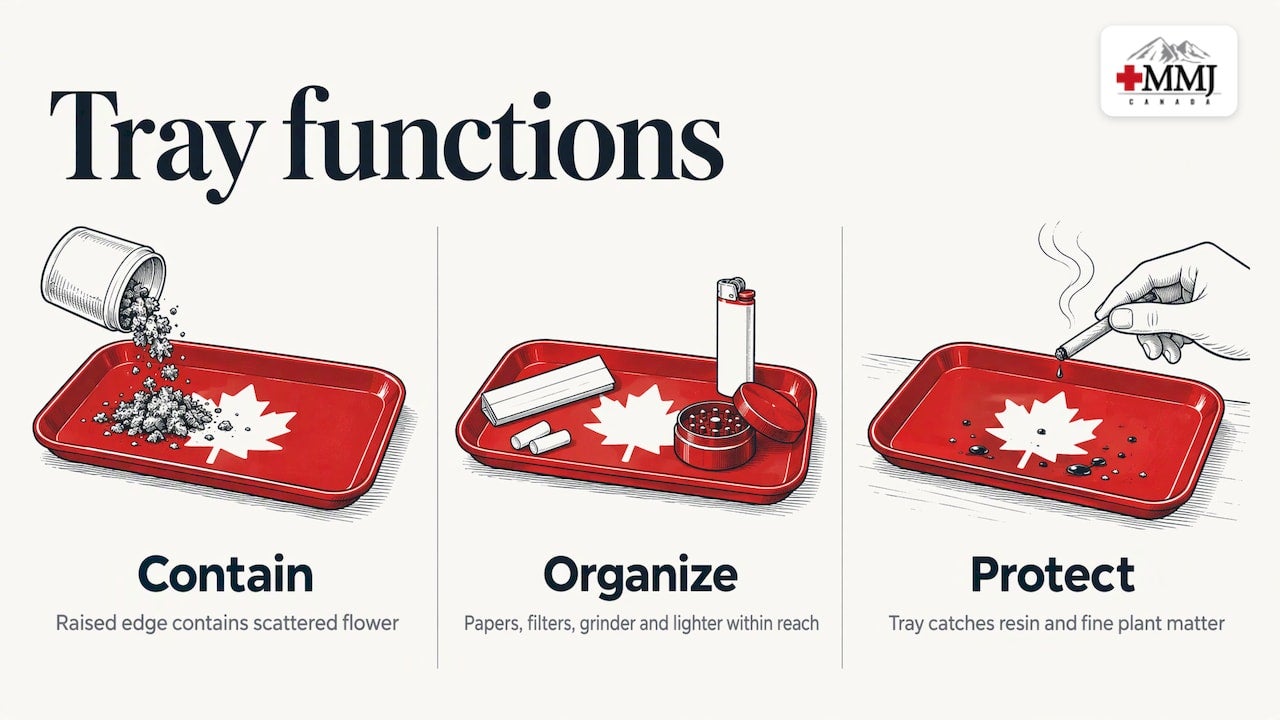
Strip away the designs and a rolling tray does three jobs.
It contains the mess. Ground flower is light and scatters easily. A raised edge stops it sliding off a table, a couch cushion or your lap. Whatever lands in the tray can be tipped back into the paper, not swept off the floor.
It keeps your kit in one place. Papers, filters, a grinder, a lighter and a pen or poker all sit within reach. When you can see everything, you stop hunting for the filter halfway through a roll.
It protects the surface. Resin and fine plant matter stick to wood, fabric and glossy tables. A tray takes that residue instead, and it is much easier to wipe than a coffee table.
If you roll on the go, a tray also gives you a flat, stable work area on your knees, in a car seat or on a bench. For people who vary how they use cannabis, from a casual evening joint to a planned session with friends, the tray is the one accessory that makes every method tidier.
Choosing a tray: size, edges, material
Three decisions matter. Make them in this order.

Size
Trays are usually sold in rough categories: pocket or travel, small, medium, large and oversized party trays. Exact dimensions differ from maker to maker, so use the category as a guide and check the measurements on the product page.
- Small or pocket: best if you roll for yourself, carry your kit in a bag or just want a minimal setup. It holds a grinder, a pack of papers and a little flower, and nothing else.
- Medium: the practical middle. There is room to spread out, hold a grinder and a lighter, and roll several joints without flower reaching the edge. This is the safest choice if you are unsure.
- Large: worth it for shared sessions or if you keep a full kit on the tray (jars, scale, several paper types). It needs more table space and is harder to store.
A useful rule: your tray should be big enough that your hands never leave it while rolling, and small enough that you will actually take it out of the drawer.
Edge shape
Look for a raised rim that is high enough to hold flower in when you tilt the tray to funnel it back, and smoothly curved at the corners. Sharp right-angle corners trap fine material and are harder to wipe. Gentle curves let you slide everything to a spot and pour it where you need it. Shallow, rolled edges are enough for rolling. Deeper ones suit trays that also hold a grinder or jar.
Material
| Material | Strengths | Watch for |
|---|---|---|
| Metal (usually aluminum or tin) | Light, sturdy, wide choice of designs, easy to wipe | Can dent if dropped or pressed hard, and may corrode if left wet |
| Wood or bamboo | Natural look, warm to the touch, often with built-in compartments | Needs to be kept dry and wiped carefully so resin does not soak in |
| Glass | Smooth, easy to clean, looks good on a table | Heavier and breakable, so it stays home |
| Silicone | Flexible, drop-proof, packs flat for travel | Can hold on to fine residue, so wipe it thoroughly |
Metal is the usual starting point because it balances weight, price and cleanup. Wood suits a permanent home setup. Silicone suits travel. Glass is for a display piece that happens to work.
Optional extras
Some trays add a magnetic lid, a built-in grinder card holder, a small compartment for papers or a rolling-machine recess. They are handy if you want everything in one box, but none is essential. A plain tray with good edges will serve you better than an elaborate one with poor ones.
What to put on it
A good setup is short. Think of the tray as a workstation, not a storage unit.
- Flower in a grinder. Evenly ground flower rolls more evenly and burns more evenly. Keep the grinder on the tray, not beside it, so pollen and fragments stay in your work area.
- Papers. Choose size and material to suit how much you roll. Rolling papers in a thin, natural paper are a common pick.
- Filters or tips. They hold the shape of the end and keep the joint from collapsing.
- A poking tool. A pen works, but a small tool packs the flower more evenly.
- A lighter. Last on the tray, first to leave it.
If you would rather skip rolling on busy days, pre-rolled joints mean the tray only needs to hold the lighter and an ashtray.
How to roll cleanly on a tray
- Clear the tray and wipe it dry. Moisture makes papers stick and turns loose flower into clumps.
- Grind into the tray’s corner or the grinder base. Keep the heap well inside the rim.
- Fold the filter and lay it at one end of the paper. Place it before you add flower so you do not have to shift material around it.
- Spread the flower along the paper. Use a line, not a pile. Pack lightly: too tight and it will not draw, too loose and it burns fast.
- Roll, tuck, seal. Roll the paper back and forth between your fingers first to shape it, then tuck the loose edge and lick the gum strip.
- Tip the leftover back. Use the tray’s curve to funnel what remains into the grinder or a jar.
The tray earns its place at step six. Leftover flower from five or six joints adds up to a meaningful amount over a month, and the tray is what lets you collect it.
Keeping the tray and the area clean
Resin builds up quietly, and a dirty tray makes everything stick, from papers to fingers.
- Wipe after every session. A dry cloth lifts loose herb. A damp cloth handles light residue.
- Deep clean when it gets tacky. Use warm soapy water for metal, silicone and glass, then dry thoroughly. For wood and bamboo, a barely damp cloth is safer than soaking, because water can swell or warp the material.
- Dry fully before storing. Moisture is the main enemy of aluminum and wood. A tray stored wet will mark or corrode.
- Store cool and dry, out of direct sunlight. Heat and light also degrade flower itself, so the same drawer is a good home for your jar.
- Keep it out of reach of children and pets. Cannabis products, including flower and edibles, should be stored securely and away from kids and animals. If a child or pet swallows cannabis, call poison control or a veterinarian promptly.
Use the tray as a work surface, not a long-term stash holder. Put flower back in its sealed container when you finish.
Indoor vs outdoor cannabis: what changes on the tray
Once your setup is sorted, the next question is usually the flower itself. Labels and shop descriptions often say whether a strain was grown indoors or outdoors. What does that mean?
Indoor cultivation takes place in a controlled space with artificial lighting, temperature and humidity control and filtered air. Outdoor cultivation takes place in a field or garden, using sunlight and local weather.
A Nuffield Scholar report on cannabis cultivation describes the trade-off from the grower’s side. Outdoor growing is generally the cheapest to set up and run, but carries the highest risk of crop loss and typically yields the lowest-value dried biomass. Indoor facilities cost the most to run because of lighting, dehumidification, heating and cooling, air filtration and supplemental CO2, yet they can more reliably produce very high-quality flower that sells at higher prices.
Control also affects yield. A 2023 review of cannabis production technology reports that dry flower yields can approach 400 g per square meter per crop cycle under ideal conditions, and that annual yields can exceed 2 kg per square meter when 4 to 5 crops are grown each year. That kind of repeat cropping is what controlled indoor environments make possible.
Pests are the other big difference. The same review notes that approximately 300 insect species have been found to attack cannabis. The Nuffield report adds that outdoor growers should avoid sites near other intensive horticulture because the surrounding pest load is too high, and that integrated pest management is essential, since very few agrichemicals are considered safe for a crop that is heated and inhaled.
What this means when you buy
- Consistency: indoor flower tends to be more uniform from batch to batch, because the growing conditions are managed. Outdoor flower can vary with the season.
- Price: because indoor production costs more, indoor flower often sits at a higher price point.
- Quality assurance: where the flower was grown matters less than whether it was tested. Lab testing is how you know a product has been checked, whichever way it was grown. Our products are lab-tested and sold in line with Canadian regulations.
- Preference: some people simply like the look, aroma and effect of one over the other. Try small amounts of different strains and note what suits you.
You can browse the full range in our flower category.
Rolling trays for different readers
Cannabis enthusiasts exploring new strains. A medium tray with a clean surface helps you compare flower side by side: appearance, grind, aroma. Keep a separate cloth for each so scents do not mix.
Patients using cannabis for medicinal purposes. Consistency matters most. A tray with compartments makes it easy to measure the same amount each time and keep supplies together. Talk to your doctor or pharmacist about what is right for your condition, and about how rolling and smoking compare with other forms.
Health-conscious users. If you prefer not to inhale, a tray still helps with grinding and handling flower for other uses. Our CBD products and edibles offer other ways to use cannabinoids.
Pet owners. A tray is not for pets. CBD for animals comes in pet-specific products. Keep trays, flower and papers out of reach of animals.
Where to get a tray and the rest of the kit
We sell cannabis accessories alongside flower, edibles, vapes, concentrates, CBD, topicals and beverages. That matters for a simple reason: the tray, papers and flower you need for a session can go in one order, and every cannabis product we sell is lab-tested and compliant with Canadian regulations.
Two trays to start with: the Toke rolling tray and the Oso Fuego small rolling tray. Pair either with Smoking Brown rolling papers and you are ready to roll.
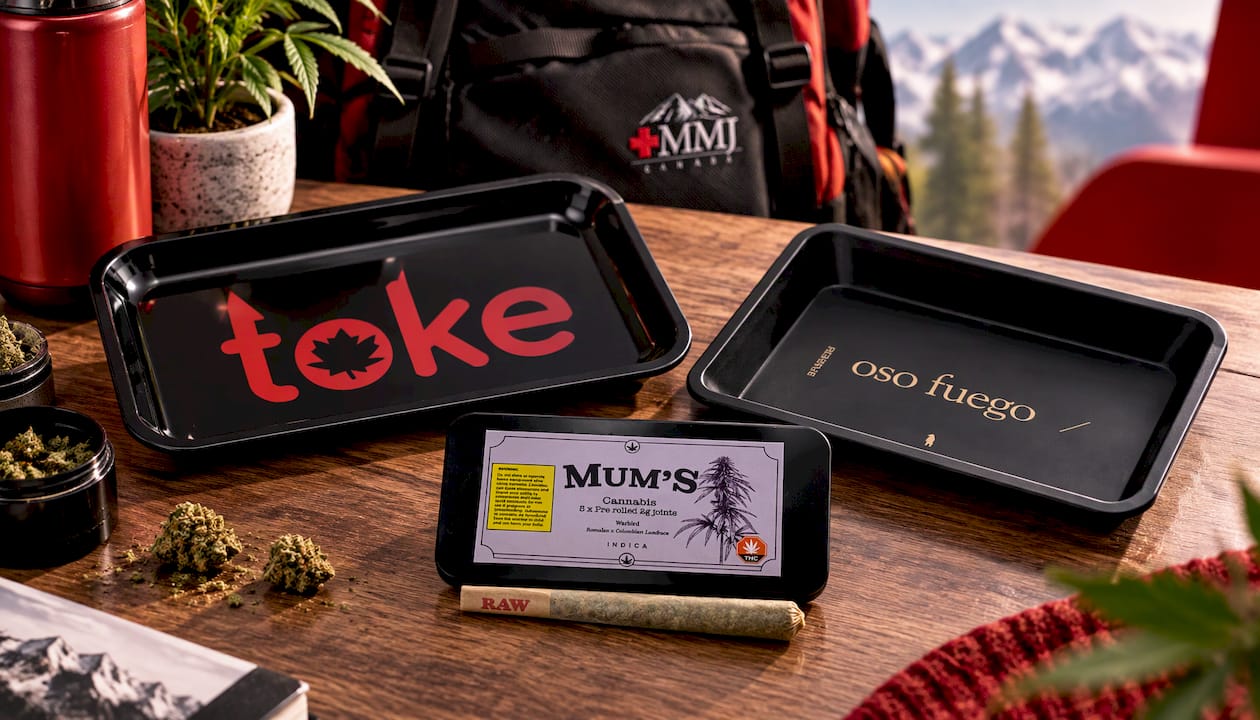
If you want to see everything we carry for your setup, the accessories page lists it, and the MMJ Canada homepage shows every category. Our service is for adults in Canada.
A quick buying checklist
- Size: medium if unsure, small for travel, large for groups.
- Edges: raised, smoothly curved, no tight corners.
- Material: metal for everyday use, wood for a home setup, silicone for travel, glass for display.
- Cleanability: can you wipe it in under a minute?
- Storage: does it fit the drawer or bag where it will live?
- Extras: only the ones you will use.
A tray that matches how you actually roll will make more difference than any feature on a spec sheet.
FAQ
What size rolling tray should I buy?
A medium tray is the best default. It gives you room for papers, a grinder and a lighter without taking over a table. Choose small if you travel or roll alone, and large if you share sessions or like a full kit laid out.
What is the best material for a rolling tray?
Metal suits most people: it is light, durable and wipes clean. Wood and bamboo look good and often have compartments, but need to be kept dry. Silicone is the pick for travel, and glass works best as a home piece. Choose based on where you will use it.
How do I clean a rolling tray?
Wipe it after each use with a dry cloth, and wash metal, glass and silicone with warm soapy water when resin builds up. Dry it completely before storing. For wood, use a lightly damp cloth rather than soaking it.
Is indoor or outdoor cannabis better?
Neither is better in every case. Indoor growing gives the grower more control over conditions and tends to produce more consistent flower at a higher cost. Outdoor growing is cheaper but more exposed to weather and pests. Pick by what you like, and look for lab-tested products either way.
Can I use the same tray for different strains?
Yes. Wipe it between strains so aromas and residue do not mix, especially if you are comparing flavors.
Sources
- Cannabis in Australia: cultivating at scale and lessons learned (Nuffield Scholar report, 2025)
- A comprehensive review of the production technology of Cannabis sativa L. (2023)