

CBD cream is a topical product you rub into the skin over a sore joint, such as the knuckles, thumbs, knees or hands. People use it for localized comfort rather than whole-body effects. The best way to use it is to pick a cream with a clearly stated CBD amount and a full ingredient list, apply it to intact skin as directed, keep a short symptom diary, and tell the clinician who treats your arthritis. At MMJ Canada, we sell lab-tested CBD and topical products to adults in Canada, and this guide covers the choosing and using part in plain terms.
TL;DR
- CBD cream is applied to the skin over a joint for localized comfort. It is not a replacement for the treatment your rheumatologist or doctor prescribes.
- A small 2022 crossover trial in thumb-joint arthritis used a 6.2 mg/mL CBD topical twice daily for two weeks and reported improved pain and disability outcomes.
- Read the label for the CBD amount per container, the full ingredient list and the directions. Use the cream on intact skin only.
- CBD may interact with some arthritis and pain medicines, so talk to your clinician before you start, especially if you take regular medication.
- Adults in Canada can browse lab-tested CBD products and topicals in our shop.
Table of Contents
- What CBD cream is used for
- How topical CBD is thought to work
- What a small trial on thumb arthritis looked at
- How to choose a CBD cream
- How to apply CBD cream to a painful joint
- Safety, interactions and when to see a clinician
- Where our products fit
- A sensible way to start
- FAQ
- Sources
What CBD cream is used for
CBD (cannabidiol) is one of the compounds in the cannabis and hemp plants. Unlike THC, it is not what produces a “high.” A CBD cream, balm, gel or ointment combines CBD with a base such as shea butter, plant oils or wax, and sometimes other ingredients like menthol, camphor or botanical extracts.
People searching for CBD cream for arthritis, joint pain or general aches usually want one of these things:
- Comfort in a specific, visible spot: a swollen knuckle, a stiff thumb base, a sore knee after a walk.
- A product that stays local, rather than something they swallow or inhale.
- A routine to add to the things they already do, such as gentle exercise, warm showers and stretching.
The Arthritis Foundation notes that CBD products come in several forms, and topicals are the ones applied directly to the skin. A cream is a different tool from a gummy or a tincture. An oral product travels through the digestive system and the bloodstream, while a topical is meant for the area under your hand. Our guide to cannabis tinctures explains the oral route if you want to compare the two.
Arthritis is not one condition
Arthritis covers many conditions. Osteoarthritis comes from wear and changes in the joint. Rheumatoid arthritis and psoriatic arthritis are inflammatory diseases of the immune system, and they usually need disease-modifying treatment from a specialist. A cream is for comfort at the skin’s surface. The Arthritis Foundation advises people with inflammatory arthritis not to replace their prescribed treatment with CBD, and that advice is worth following whatever product you choose.
How topical CBD is thought to work
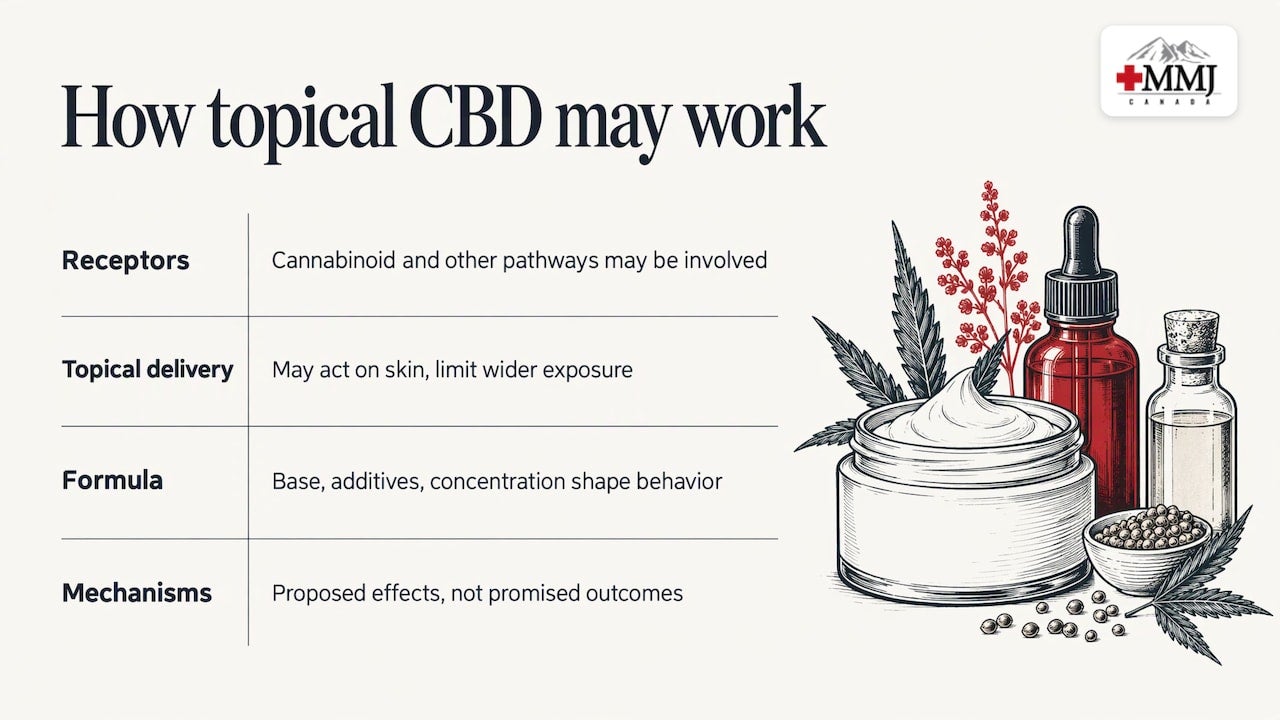
The body has a network of receptors that scientists call the endocannabinoid system. A 2022 review of CBD in rheumatic diseases says CBD’s mechanisms may involve cannabinoid receptors and other, non-cannabinoid receptors, including pathways linked to inflammation and pain. You can read the details in that review of CBD in rheumatic diseases. These are proposed mechanisms, which means they describe how researchers think CBD might act, not a promise of what a given cream will do for you.
The appeal of a topical is its target. A dermatology review in the journal literature sees potential for topical delivery to act on the skin while limiting exposure elsewhere in the body, and it stresses that reliable use depends on a verified formulation. The review on safety and sourcing of topical cannabinoids is clear on one practical point: the formulation matters. The base, the additives and the CBD concentration all shape how a cream behaves.
That is why two creams that both say “CBD” on the front can feel quite different. When you choose, you are choosing a whole formula, not just a cannabinoid.
What a small trial on thumb arthritis looked at
The most useful study for a reader asking about creams is a 2022 randomized controlled trial of topical cannabidiol in people with symptomatic arthritis at the base of the thumb. Here is what it did:
- Eighteen people took part.
- Each used 1 mL of a CBD topical (6.2 mg/mL, in shea butter) twice a day for two weeks, and separately used a plain shea butter control for two weeks.
- A washout period sat between the two phases, and then the groups swapped, which is what “crossover” means.
- The investigators reported improved pain and disability outcomes and no adverse events.
It is a small trial, so think of it as a good example of how a topical can be studied and what a typical test concentration looks like, not as a guarantee. It is one reason people with hand and thumb arthritis, where skin sits close to the joint, are curious about creams.
A practical point from this trial: the dose was a measured amount, applied on a schedule, to one defined area. You can borrow that discipline at home, as the application section below shows.
How to choose a CBD cream
You do not need a chemistry degree. You need a label you can read and a seller who is open about their products. Work through these checks.
1. The CBD amount
Look for the total milligrams of CBD in the container and, ideally, the concentration per gram or milliliter. The thumb trial’s 6.2 mg/mL gives you a sense of scale, but creams on the market vary a lot, and a higher number is not automatically better for you. Pick a clear label, start with the directed amount and keep notes.
2. The full ingredient list
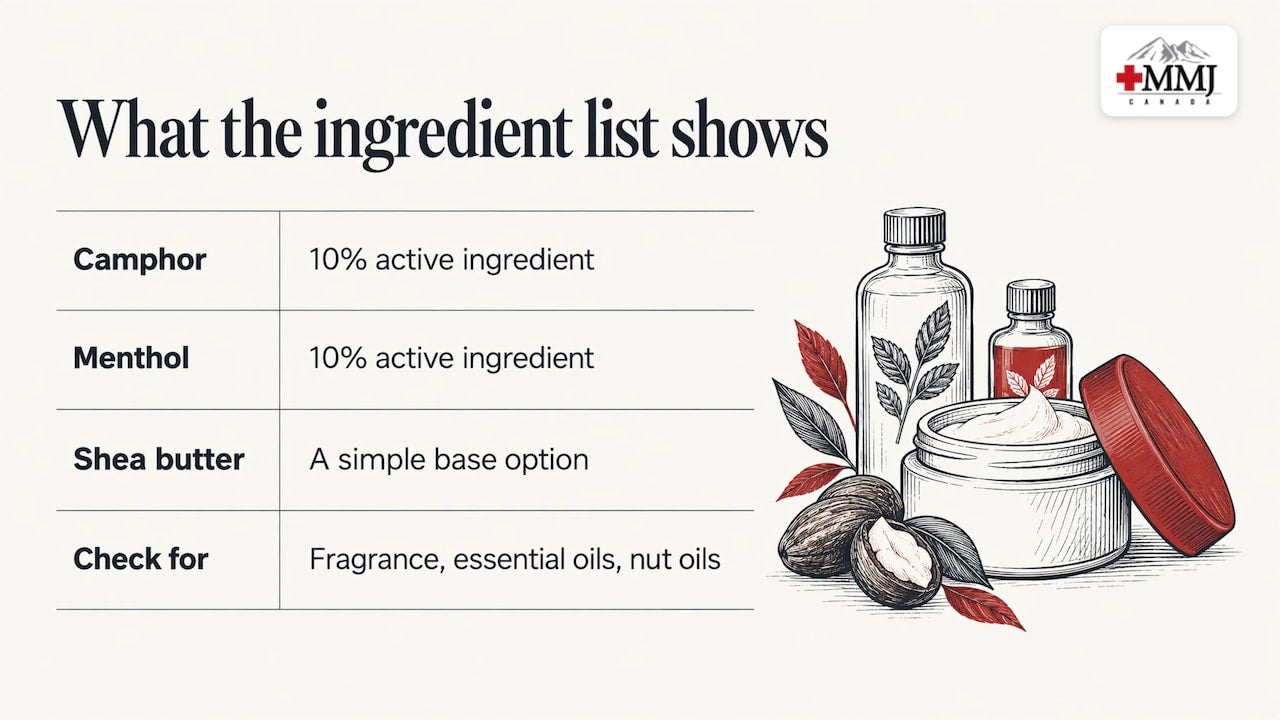
Topicals often combine CBD with other ingredients. Some people want menthol or camphor for a cooling or warming feel. Others prefer a simple base like shea butter. Read the whole list for anything you react to, such as fragrance, essential oils or nut-derived oils.
One label detail is worth understanding. In the United States, some arthritis creams that carry CBD branding list another ingredient as the active ingredient for temporary relief of minor aches. For example, a DailyMed label for an arthritis ointment names camphor 10% and menthol 10% as the actives. Reading the panel tells you what the product contains and what it says on its directions.
3. Lab testing
A third-party lab test confirms what is in the container. Every product we sell at MMJ Canada is lab-tested, and our products are made to comply with Canadian regulations. When you shop, look for that same testing and compliance information on any product you buy.
4. The format
Creams spread easily and suit larger areas like knees and shoulders. Balms and ointments are thicker and can suit small spots such as knuckles. Gels feel lighter. The right format is the one you will actually apply consistently.
5. Your skin
If you have sensitive skin or a history of reactions, test a small patch on your inner forearm and wait a day before using it on the joint.
You can see the creams, balms and related products we carry in our Topicals category and in our wider CBD products collection.
How to apply CBD cream to a painful joint
A steady routine makes it easier to see how a cream works for you.
- Wash and dry the skin. Apply only to clean, intact skin. The directions on the DailyMed arthritis ointment label say it is for external use only and not for wounds or damaged skin.
- Measure the amount. Follow the label. If it gives no amount, begin with a pea-sized to coin-sized portion per joint, so you can repeat the same quantity each time.
- Massage gently until absorbed. Work the cream in over the joint and the muscles around it. Wash your hands afterward and keep it away from your eyes and mouth.
- Skip tight wraps and heating pads. The same label advises against tight bandages and heating pads over the area, because heat can change how a topical feels on the skin.
- Repeat on a schedule. The thumb trial used twice-daily application. Choose a pattern you can keep, such as morning and evening.
- Keep a simple diary. Write down the product, the amount, the time and your pain and stiffness on a 0 to 10 scale. The Arthritis Foundation recommends tracking symptoms and dose in this way, and the notes give your clinician something concrete to review.
- Pair it with movement. Gentle range-of-motion exercises, walking and stretching are the foundations of arthritis self-care, and a cream fits alongside them.
Safety, interactions and when to see a clinician
A cream is applied to the skin, but it is still a CBD product, and the same care applies.
- Talk to your clinician first. The Arthritis Foundation advises people to discuss a CBD trial with the clinician treating their arthritis, particularly if they take medicines. Its CBD guide says CBD may interact with some arthritis and pain medicines and may cause liver damage or fertility issues. If you take anything for rheumatoid or psoriatic arthritis, ask your rheumatologist or pharmacist before you begin.
- Do not stop prescribed treatment. CBD is not a substitute for disease-modifying treatment for inflammatory arthritis.
- Stop if skin reacts. Redness, itching or burning that does not settle means you should wash the area and stop using the product. The DailyMed label advises stopping and asking a doctor if symptoms persist for more than seven days, worsen, recur or cause excessive irritation.
- Broken skin and new swelling. Do not apply to wounds or damaged skin. A joint that is suddenly hot, red and very swollen, or pain after an injury, needs a doctor, not a cream.
- Pregnancy and breastfeeding. Ask your doctor before using any CBD product.
- Keep it for adults. Store creams out of reach of children.
Rules differ by country. In Canada, cannabis products are regulated federally, and we sell to adults in Canada only. If you live elsewhere, check what is legal where you are before ordering.
One note for pet owners: a cream made for people is not a pet product. Ask your veterinarian about anything you plan to put on an animal, and look at pet-specific products rather than sharing your own.
Where our products fit
We built our shop around products you can look up, read about and compare. For joint comfort, start in the Topicals category, where you will find topical products you apply directly to the skin. Our CBD products page lists the wider CBD range for adults in Canada, including products you take by mouth, such as CBD gummies. Every product we sell is lab-tested and sold in line with Canadian regulations, and the shop is designed to be easy to browse.
If you want background before you buy, our article on cannabis for chronic pain explains the different ways people approach long-term pain. When you are ready, you can browse our full range.
A sensible way to start
Here is a plan you can take to your next appointment:
- Name the joint or joints you want help with, and rate your usual pain and stiffness for a week.
- Share the product label with your clinician or pharmacist, including the ingredients and CBD amount.
- Pick one cream, apply the same measured amount on a fixed schedule, and change nothing else in your routine for two weeks, which matches the length of the thumb trial.
- Review your diary. Note what changed, and bring it to your next visit.
Changing one thing at a time is the simplest way to know what is helping.
FAQ
Is CBD okay for arthritis?
Many adults with arthritis ask about CBD, and the Arthritis Foundation recommends discussing it with the clinician who treats your arthritis first. That matters most if you take medicines, because CBD may interact with some arthritis and pain medicines. A topical is applied to the skin, but the same conversation applies.
What is CBD cream used for?
People use CBD cream on the skin over sore joints and muscles for localized comfort. It is applied to hands, knees, shoulders and similar areas. It is a topical product, so it is used differently from gummies, tinctures or vapes.
How often should I apply CBD cream for joint pain?
Follow the directions on your product’s label. The 2022 thumb-joint trial used a measured 1 mL dose twice daily for two weeks, which is a useful model for keeping a consistent routine. Track the amount and your symptoms in a diary so you can review them with your clinician.
Can I use CBD cream on broken skin?
No. Use topical products on intact skin only. Labels for external-use pain products say not to apply them to wounds or damaged skin, and to stop and see a doctor if irritation is excessive or symptoms last more than seven days.
Does CBD cream replace my arthritis medication?
No. The Arthritis Foundation says CBD is not a substitute for disease-modifying treatment for inflammatory arthritis. Keep taking what your clinician prescribes and discuss any addition to your routine first.
Sources
- A Randomized Controlled Trial of Topical Cannabidiol for Thumb Basal Joint Arthritis (PubMed, 2022)
- Cannabidiol (CBD) in Rheumatic Diseases (PubMed Central, 2022)
- Safety and Sourcing of Topical Cannabinoids (PubMed Central, 2021)
- CBD for Arthritis Pain, Arthritis Foundation (2024)
- DailyMed: arthritis aches and pain relief ointment label (US National Library of Medicine)