

For a first edible, start with 2.5 mg of THC or less, then wait at least two hours before you think about more. That is the figure Canadian health authorities and several US regulators converge on, and it only works if you can read the milligrams on the label and give the edible time to act. This guide covers both, plus what to expect and what to do if you overshoot. Our own range is for adults in Canada, and the label-reading habits below apply to any edible you buy.
TL;DR
- Beginners should start at 2.5 mg THC, or 1.25 mg if you are over 55, have certain health conditions or take medications that may interact with THC and CBD, per Health Canada.
- Check milligrams per piece and per package. A pack of four pieces at 2.5 mg each holds 10 mg in total.
- Effects can start within 30 minutes to 2 hours and be strongest at 2 to 4 hours. Do not redose early.
- Wait at least two hours before a second 2.5 mg dose, and longer if you can.
- If you feel unwell, stop, and contact poison control or emergency services as described below.
Table of Contents
- Start with the label: milligrams per piece versus per package
- How much edible to take: starting doses by experience
- How long edibles take to kick in
- Why waiting matters: dose stacking
- A first-time edible plan
- If you took too much
- Pets and edibles
- Where our edibles fit
- FAQ
- Sources
Start with the label: milligrams per piece versus per package
Most dosing mistakes begin with the label. An edible lists THC in milligrams (mg), but that number can describe one piece or the whole package.
Health Canada’s label guide gives the example of four edible pieces at 2.5 mg THC each, which makes 10 mg in the package. Labels can also show THC by weight (for example 180 mg/g in a 30 g package, which is 5,400 mg in total) or as a single total figure, and they must show net weight or volume and the number of units.
In Canada, regulated edibles are limited to 10 mg of THC per package, according to CMAJ. In Washington State, the cap is 10 mg per serving and 100 mg per package. So the same “100 mg” gummy tub can be perfectly normal in one place and not on sale in another, and it can hold ten standard servings.
Before you buy, do this arithmetic:
- Find the mg of THC per piece.
- Find the number of pieces.
- Multiply to get the package total.
- Decide how many pieces equal your starting dose. If a gummy holds 10 mg and your dose is 2.5 mg, that is a quarter of one gummy.
Splitting is where things go wrong. CMAJ notes that cutting a product into very small portions, such as one-tenth of a 100 mg cookie, is impractical and a common cause of overdose, because the THC is rarely spread evenly. Products made in smaller, clearly marked units take the guesswork out of it. Our low dose edibles guide explains what counts as low in practice.
How much edible to take: starting doses by experience
There is no standardized dose that suits everyone. Health Canada’s medical guidance says that each person has to find their own dose, ideally with a health care provider. What the authorities do agree on is where to begin.
| Who | Suggested starting THC dose | Source |
|---|---|---|
| First-time or infrequent user | 2.5 mg or less | Council of Chief Medical Officers of Health, Canada |
| Oral use, general adult | 2.5 mg once per day | Health Canada |
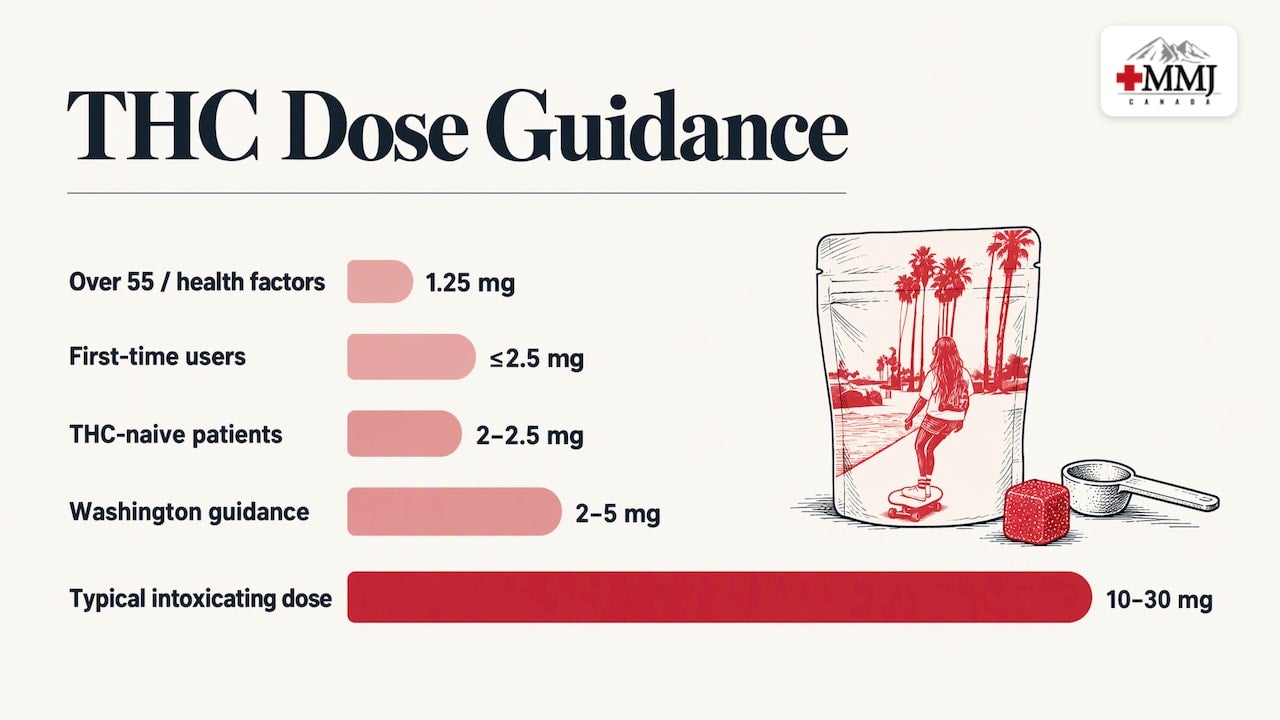
| Over 55, certain health conditions, or medications that may interact | 1.25 mg | Health Canada |
| Washington State guidance | 2 to 5 mg, possibly by cutting an edible into halves or quarters | Washington LCB |
A physician quoted by Northwell Health recommends 2 to 2.5 mg for THC-naive patients, often a quarter of a standard gummy, and says 5 to 10 mg is too much for a beginner. CMAJ describes a typical intoxicating dose as 10 to 30 mg. That gap is worth noticing: a 10 mg product is a normal retail unit, but it is a strong first experience for someone with no tolerance.
The public health statement also advises choosing products with a low amount of THC and an equal or higher amount of CBD to reduce the risk of overconsumption. CBD (cannabidiol) is the non-intoxicating cannabinoid. If you want to compare how the two behave, our piece on CBD versus THC for anxiety is a good next read.
If you take CBD instead of THC
Health Canada’s guidance for oral CBD is to start with 25 mg of CBD per day, which can be split into two doses of 12.5 mg or three of about 8.3 mg. CBD products can also contain some THC, so check the label to see how much THC each CBD dose delivers. Some patients begin with CBD products before trying any THC, according to the same page. Our CBD products show their cannabinoid content per product, and if sleep is your goal, CBD for sleep covers how people use it.
How long edibles take to kick in
Edibles are digested before the THC reaches your bloodstream, so they act far later than smoking or vaping. The published ranges differ a little, which tells you the real answer depends on you:
- Health Canada: effects start within 30 minutes to 2 hours, the strongest effects can come at 2 to 4 hours, and they can last 4 to 8 hours.
- British Columbia’s edibles fact sheet: 30 minutes to 2 hours to begin, up to 4 hours for full effects, intoxication lasting up to 12 hours and residual effects up to 24 hours.
- JAMA Internal Medicine: up to 2 hours to take effect, a peak around 4 hours and effects lasting up to 24 hours.
Plan for the long end. Do not schedule a drive, a work call or caring for anyone else for the rest of the day. British Columbia advises keeping at least eight hours free after overconsumption, with no driving, no machinery and no responsibility for others.
Why the same dose hits people differently
The BC fact sheet says onset and duration depend on body weight, metabolism, sex and whether you ate cannabis on an empty stomach. Health Canada adds product format and other oral medications to the list. A gummy on an empty stomach and a brownie after dinner are not the same experience at the same milligram count.
Older adults deserve particular care. JAMA Internal Medicine reports that age-related changes in metabolism can make effects stronger, that older adults are the most likely to have cannabis-related emergency visits, and that interactions are possible with sleeping pills, blood thinners, anti-anxiety medications and painkillers. If you take any of these, talk to your doctor or pharmacist before trying an edible.
Why waiting matters: dose stacking
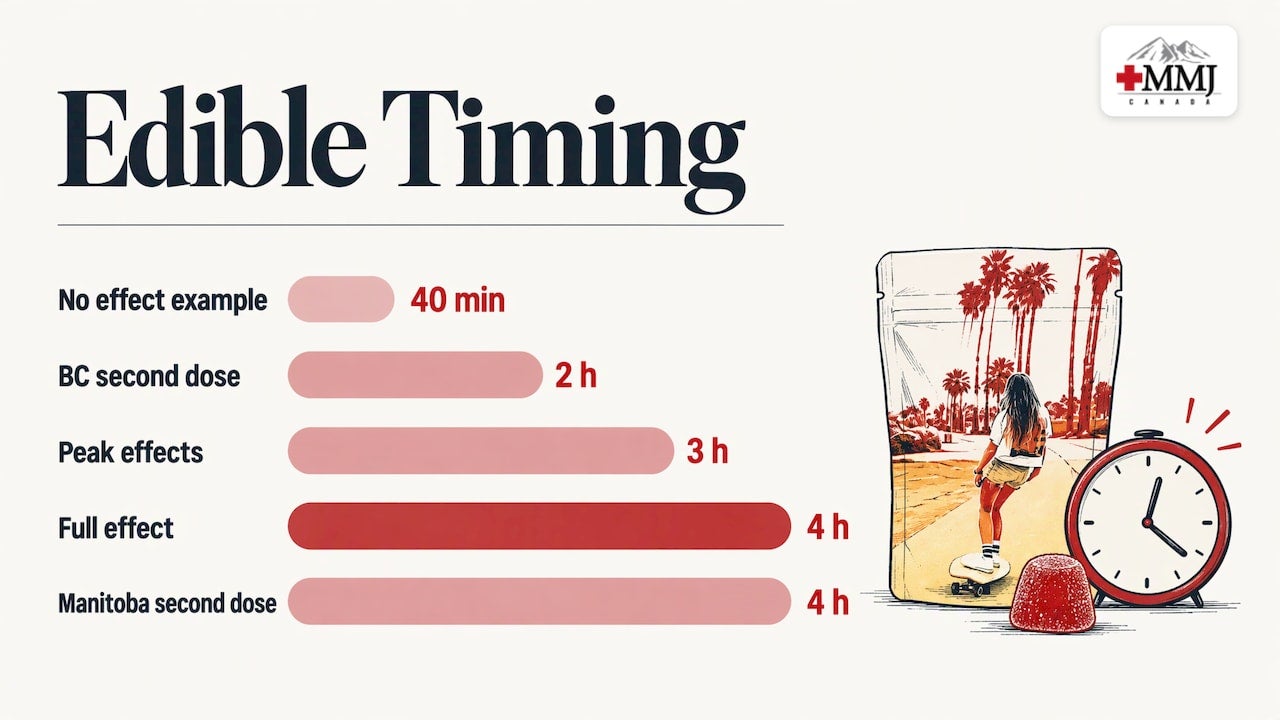
Someone used to inhaling feels the effect in minutes. Eat a gummy, feel nothing at 40 minutes, eat another, and both can arrive together. CMAJ calls this dose stacking and notes that peak effects arrive around 3 hours after eating. The American Heart Association likewise cautions against stacking oral doses and advises consuming edibles slowly, in small quantities and with enough time between doses.
The rules on spacing differ slightly by source, so use the cautious end:
- British Columbia: wait at least two hours before a second 2.5 mg dose.
- Public health statement: wait up to 2 hours to feel effects and up to 4 hours for the full effect before taking more.
- Manitoba: wait at least four hours before a second serving.
- Washington LCB: after waiting and feeling fine, take the same amount or less, not double.
If you are unsure, do not take more that day. The next day you will have a clearer sense of your dose.
A first-time edible plan
This is a plain routine built from the guidance above.
- Pick a product with clear per-piece dosing. Look for the mg of THC per unit on the label, and choose a low number. Our edibles range lists the THC content for each product.
- Choose the setting. Northwell’s physician suggests taking a first dose at night, at home, with nothing else planned.
- Take 2.5 mg, or 1.25 mg if you fall into the older-age, health-condition or medication group. Note the time.
- Wait at least two hours. Drink water, stay put, and avoid mixing with alcohol.
- Decide on more only if you feel comfortable. Take the same amount or less, never double, and then wait again.
- Write down what you took and how it felt. Next time you start from what worked.
If you find that you need ever larger amounts for the same effect, the same physician recommends a short break from THC to reset sensitivity.
If you took too much
A too-strong dose is unpleasant and can be frightening, but there are clear steps. Manitoba states that you cannot die directly from taking cannabis, yet it is possible to overdose and feel physically ill, extremely anxious or paranoid. Provincial guidance adds that the risk is highest with homemade edibles, since the dose cannot be measured accurately.
Signs of too much THC include:
- sleepiness, confusion, dizziness and loss of coordination
- nausea and vomiting
- a fast or pounding heartbeat
- panic, paranoia, or losing contact with reality
- in serious cases chest pain, seizures or loss of consciousness, per a Health Canada notice
What to do: stop using cannabis, stay somewhere calm with someone you trust, and do not drive. For chest pain, panic attacks or seizures, Manitoba advises seeking immediate medical attention. For lesser symptoms, its poison control line is 1-855-776-4766. In British Columbia, call the BC Poison Control Centre at 1 800-567-8911 or 604 682-5050, or 911 in an emergency. In the United States, call 911 for an emergency or your local poison center. If a child has swallowed an edible, treat it as an emergency: JAMA Internal Medicine lists accidental exposure in children among the risks of edibles, so store them locked and out of sight in their original packaging.
Pets and edibles
Human edible dosing does not carry over to animals. Dogs process cannabinoids differently from people, and many edibles contain ingredients that are toxic to dogs on their own, such as chocolate, raisins and xylitol, according to the Saskatchewan Veterinary Medical Association guide. The same guide says marijuana toxicosis in dogs is most often linked to edibles, with signs usually appearing within 1 to 3 hours.
So keep your own THC edibles well out of reach, and if a pet eats one, call a veterinarian or animal poison service right away. If you want to give a dog CBD, use a product made for pets rather than a person’s gummy, and read our guide to CBD soft chews for dogs for dose and label checks. Your vet should set the amount.
Where our edibles fit
MMJ Canada is an online retailer of lab-tested cannabis and CBD products for adults in Canada, with products that comply with Canadian regulations. The edibles category includes gummies, hard candies and other formats, and the beverages category covers cannabis-infused drinks. Each product page shows its THC content, so you can do the per-piece arithmetic from the label section before you order.

If you are choosing for the first time, begin with the lowest-mg options and use the plan above. Our low dose edibles page helps you work out what low means for you. If you are a patient exploring options for discomfort, our overview of cannabis for chronic pain and the guide to weed for back pain explain the research. For personal dosing with a medical condition, work with a health care provider.
FAQ
How much edible should I take as a beginner?
Start with 2.5 mg of THC or less, which is what the Council of Chief Medical Officers of Health and Health Canada advise. If you are over 55, have certain health conditions or take medications that may interact with THC and CBD, Health Canada suggests 1.25 mg. Wait at least two hours before considering a second dose.
How long do edibles take to kick in?
Official Canadian guidance puts onset at 30 minutes to 2 hours, with the strongest effects at 2 to 4 hours. Effects can last 4 to 8 hours or longer. Eating on an empty stomach, your weight and your metabolism all change the timing.
Is 10 mg too much for a first edible?
For most first-timers, yes. A single regulated Canadian package can hold up to 10 mg, which the public health statement calls a large amount for a first-time or infrequent user. Take a fraction of a product only when it is made to be divided, and otherwise pick a lower-mg product.
Can I take another edible if I feel nothing after an hour?
Not yet. Edibles can take up to two hours to begin and four to peak. Wait at least two hours before a second 2.5 mg dose, and Manitoba advises at least four hours before a second serving. Taking more too early is the most common way people end up overdoing it.
Do CBD edibles follow the same dosing rules?
Not exactly. Health Canada’s starting point for oral CBD is 25 mg per day, split into two or three doses. CBD products can contain some THC, so read the label for the THC delivered per dose.
Sources
- How to read and understand a cannabis product label (Health Canada)
- Cannabis for medical purposes: using a cannabis product (Health Canada)
- Council of Chief Medical Officers of Health statement on cannabis extracts, edibles and topicals
- Edible cannabis (CMAJ)
- Reading a product label (Washington State Liquor and Cannabis Board)
- What is the right amount of cannabis for me? (Washington State Liquor and Cannabis Board)
- Good and bad experiences with cannabis (Province of Manitoba)
- Cannabis myths (Province of Manitoba)
- I am curious about cannabis edibles (JAMA Internal Medicine)
- Medical marijuana, recreational cannabis, and cardiovascular health (American Heart Association)
- Are edibles safe? A doctor’s guide to cannabis gummies (Northwell Health)
- Health Canada recall notice on edibles and overconsumption
- Cannabis: what veterinarians need to know (Saskatchewan Veterinary Medical Association)