

For most concentrates, a good dab temperature sits between about 400°F and 600°F. Low-temp dabs (roughly 400–500°F) favor flavor and smoothness, mid-range dabs (roughly 500–550°F) balance taste and potency, and hotter dabs trade flavor for bigger clouds. The number on your device is only part of the story, though. Where it is measured, what you are dabbing and how much you load all change what actually reaches your lungs. Here is how to pick a temperature, adjust it by concentrate, and stay well below the heat where vapor turns into combustion.
TL;DR
- Start low: around 400–500°F gives the most flavor and the gentlest inhale. Step up in small increments if the hit is thin.
- Delicate concentrates such as rosin and full melt hash usually shine at the cooler end. Harder, more stable forms such as shatter and diamonds usually want more heat.
- Lab research on dabbing found that a harmful breakdown product of terpenes (methacrolein) was undetectable at a nail temperature of 322°C (about 612°F) and rose as the nail got hotter.
- A device display, a coil reading and the real surface temperature of your quartz can all differ, so treat any chart as a starting point and adjust by taste.
- Dry-herb vaporizing uses a lower range, about 160–230°C (320–446°F), than dabbing.
Table of Contents
- What dab temperature actually means
- Low, medium and high: what each range does
- What the research says about heat and inhalation
- Does going colder always mean cleaner?
- Match the temperature to the concentrate
- Why your device’s number may not match reality
- Cannabis vape temperature: how it differs from dabbing
- A simple routine for finding your best dab temperature
- Where to find concentrates and gear
- FAQ
- Sources
What dab temperature actually means
Dabbing is the flash vaporization of a cannabis concentrate: a small amount of oil, wax, rosin or shatter touches a hot surface, usually quartz or ceramic, and turns into vapor you inhale. Dab temperature is the heat of that surface at the moment the concentrate lands on it.
That sounds simple, but it is the most common source of confusion. The compounds you want, terpenes (the aromatic molecules that give strains their smell and taste) and cannabinoids such as THC, vaporize at different points. Many terpenes boil well below the range most people dab at, which is why a cooler dab tastes more like the strain. Heat the surface much higher and you get thicker vapor and a stronger hit, but the flavor flattens and the inhale gets harsher.
Most guides put the usable window between roughly 400°F and 600°F. Within it, three bands cover nearly every preference.
Low, medium and high: what each range does
| Range | Typical temperature | What you get |
|---|---|---|
| Low | about 400–500°F (204–260°C) | Maximum flavor, smooth inhale, thinner vapor, possible leftover oil |
| Medium | about 500–550°F (260–288°C) | Balanced taste and potency, the everyday setting for many dabbers |
| High | about 550–600°F (288–315°C) | Thick clouds, stronger effect, less flavor, rougher on the throat |
These are rules of thumb, and different guides draw the lines a few dozen degrees apart. That is normal, because each one measures heat in a slightly different place. Use the table to choose where to start, not as a target to hit exactly.
Low-temperature dabbing
Low-temp dabbing is the answer to most “best temperature” questions from people who care about taste. At the cooler end, more of the terpene profile survives, so a citrus-forward strain tastes citrusy and a gassy one tastes gassy. The vapor is thinner and cooler, which many people find easier on the throat.
The trade-off is efficiency. At lower heat some of the concentrate may not fully vaporize and can be left behind on the surface. A short second pass at the same temperature often picks it up. If you routinely leave oil behind, nudge the temperature up by 10–20°F rather than jumping a whole band.
Medium temperatures
The middle of the range is where most people settle once they know their gear. You still taste the concentrate, and the vapor is dense enough that a single inhale feels complete. If you are new to dabbing or trying a new product, this is a sensible place to begin only if you take a small amount: concentrates are far stronger than flower. Regulated dried cannabis flower is typically under 30% THC, while concentrates commonly range from 70% to 90% THC, according to a review in Drug and Alcohol Review. A rice-grain-sized dab is plenty for a first session.
High temperatures
Hot dabs, above about 550°F, produce the biggest clouds and the quickest hit. They also burn off the delicate aromatics and make coughing more likely. Beyond about 600°F you are moving toward combustion territory, where the material starts to burn rather than vaporize. There is no flavor or potency benefit worth chasing up there, and as the next section shows, the chemistry gets worse as the surface gets hotter.
What the research says about heat and inhalation
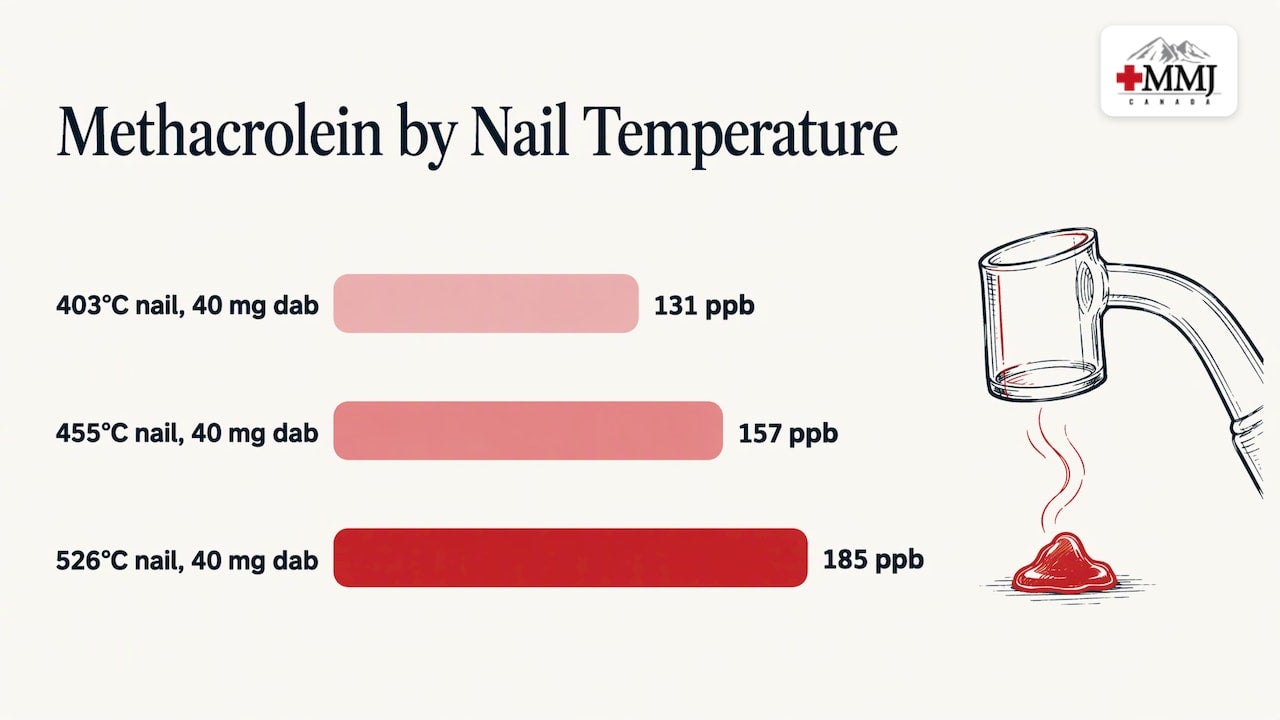
Chemists at Portland State University measured what is in dab vapor at different nail temperatures. In their concentrate vaping study, methacrolein, a respiratory irritant formed when terpenes break down, measured 131 parts per billion at 403°C, 157 at 455°C and 185 at 526°C per 40 mg dab, and was undetectable at 322°C. Benzene appeared only at the highest temperature tested.
Two takeaways for everyday dabbing:
- Cooler is cleaner. Every step up in nail temperature in that study brought more of the unwanted breakdown products. The lowest temperature produced none of the compound they tracked most closely.
- Those numbers are nail temperatures, not chart temperatures. A lab thermometer on a nail and a quartz surface reading from an infrared gun are different measurements, so do not convert one directly into the other. The practical message is the direction: lower heat, fewer byproducts.
The same research group’s earlier risk analysis found that methacrolein accounted for 91% of the non-cancer hazard index from dabbing, and that the index could exceed unity at higher nail temperatures or higher terpene content. In plain terms: very hot dabbing of terpene-rich material is the scenario to avoid.
Heat is not the only variable. Researchers at the Swiss Federal Office of Public Health tested emissions from several devices and concluded that matching the product to the device matters as much as the temperature. Dried-flower vaporizers produced no detectable PAHs or phenols in their tests, while a poorly matched extract in a pen produced high levels. Use products made for the hardware you own.
If you have a lung condition, or you are using cannabis for a medical reason, talk to your doctor before you start inhaling concentrates, and ask whether a lower-intensity format would suit you better.
Does going colder always mean cleaner?
Not indefinitely. One long-running laboratory comparison of vaporizer settings, Pomahacova and colleagues, ran a Volcano vaporizer at 170°C, 200°C and 230°C (338°F, 392°F and 446°F) and found cannabinoid output rose steeply with temperature. Very low settings give you less of everything, including the effect you are after, so you may end up taking more draws to get there.
The sweet spot is therefore a low-to-moderate range where flavor is strong, the material actually vaporizes and you are not chasing the hit with repeated, longer pulls. For dabbing that usually means the lower half of the 400–600°F window.
Match the temperature to the concentrate
Different concentrates have different textures, terpene loads and melting behavior, so one number does not fit them all. These are general starting zones, and the product’s own packaging or maker notes should override them when they give a figure.
- Rosin, live rosin and hash-based concentrates: these are valued for their terpene profile, so start at the cool end, around 400–500°F. Our guides to hash rosin and full melt hash explain what separates them from other concentrates and why they reward gentle heat.
- Live resin: a hydrocarbon extract that is often a little more forgiving, so the low-to-mid range works well. If you want to try it, our live resin from High Voltage comes in a 1 g size.
- Shatter and other hard, glassy forms: these usually need somewhat more heat to vaporize fully, so work upward from the middle of the range. Our overview of the types of cannabis in shatter bars is a good companion read.
- Diamonds and other highly crystalline products: they tend to need the warmest settings in the sensible range to melt and vaporize completely.
- Wax, kief and distillate: begin in the middle band and adjust by taste and residue.
A simple rule works across all of them: start at the lowest setting that produces a satisfying, fully vaporized hit, and move up only if you see leftover oil or the vapor feels weak.
Why your device’s number may not match reality
The figure on your screen is a reading from one spot. A few things can make it differ from the temperature your concentrate meets:
- Sensor location. Some e-rigs measure inside the chamber, others infer heat from a coil. A coil reading can differ from the surface of the quartz it heats.
- Quartz thickness and size. A thick, large banger holds more heat than a thin one, and a coil set to the same number will deliver a different surface temperature.
- Heat loss while you inhale. The surface cools quickly during a draw. The Portland State team reported that nail temperature fell noticeably over a ten-second draw, so a long, slow pull is a cooler dab than a short, fast one.
- Torch technique. With a torch there is no display at all. The heating time and the cooldown before the dab decide the temperature.
The practical fix is to learn your own setup rather than trust a chart. Pick a setting, note the flavor and residue, and change one thing at a time: temperature, amount or inhale speed. Smooth, tasty, little residue means you are in range.
If you use a torch
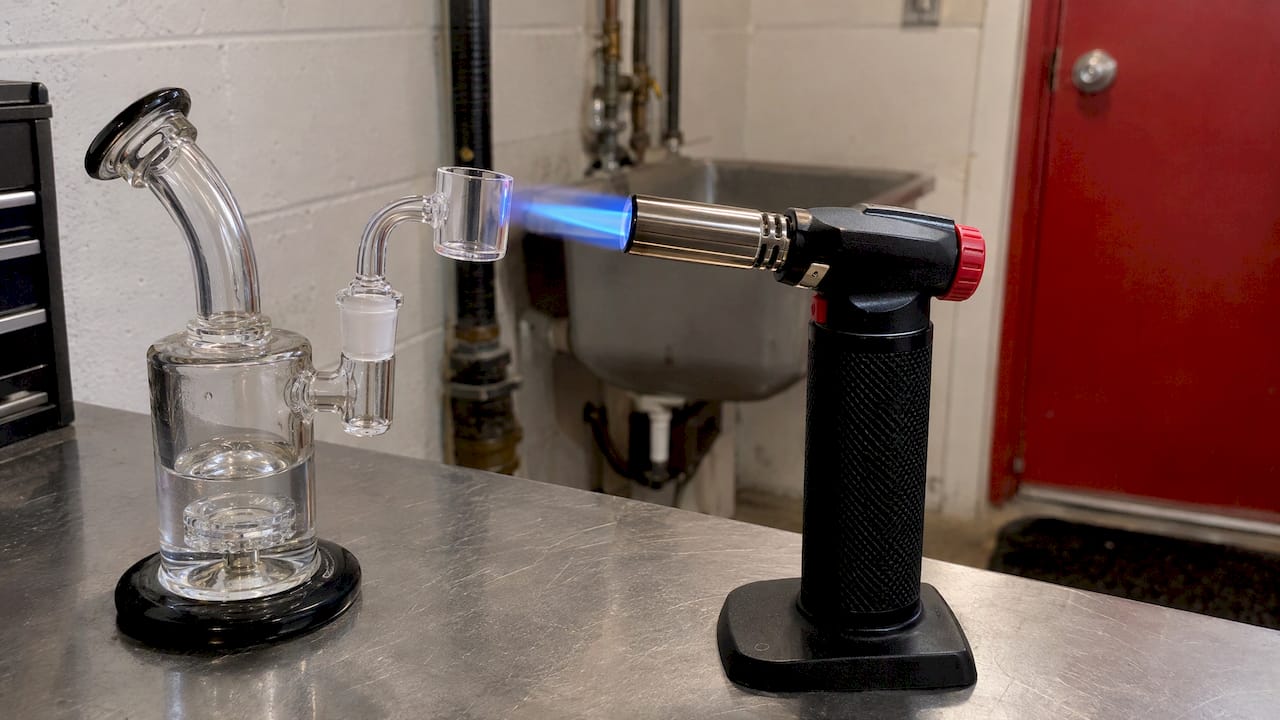
Heat the banger evenly until the quartz glows, then let it cool before you dab. A longer cooldown means a cooler dab. Start with a longer wait than you think you need, then shorten it on later sessions until the flavor and vapor density suit you. Never touch the torch flame to the concentrate itself, and keep the flame well away from anything flammable.
If you use an e-rig or dab pen
Choose the lowest preset first. Presets are designed around the device’s own sensor, so a mid preset on one model may not match the same number on another. Treat each device as its own scale.
Cannabis vape temperature: how it differs from dabbing
If you are vaporizing dried flower or using a cartridge instead of a dab rig, the numbers change. Flower vaporizers work at lower heat than dabbing. A clinical review by MacCallum, Lo and Boivin puts cannabis vaporization at about 160–230°C (320–446°F), compared with roughly 600–900°C for smoking. For patients new to vaporizing, they suggest starting around 180–200°C (356–392°F), noting that potency rises as temperature climbs toward 230°C, and dropping to 160–180°C if the throat or chest is irritated.
They also recommend a “mindful” approach: take one inhalation, wait 15 to 30 minutes to feel the full effect, and only then decide whether to take more. That advice applies equally to dabs, where the pace of onset catches people out.
The same review reports that people who vaporize cannabis are significantly less likely to report respiratory symptoms than those who smoke it. It is also why dried-flower vaporizers are the usual recommendation from a lung-health standpoint, while concentrates call for extra care with amount and heat.
Cartridges and disposables are a different case again, because the heating element and temperature are built into the device. Choose a product designed for the device you are using, and read our guide to cannabis vape pods for types, refilling and safe use. In the US outbreak of vaping-associated lung injury, CDC researchers linked vitamin E acetate strongly to cases, which is why sticking to lab-tested products from a retailer that publishes its testing matters for any inhaled format.
A simple routine for finding your best dab temperature
- Start with a tiny dab. Concentrates are potent. A small amount lets you judge flavor and effect without overdoing it.
- Begin at the low end. Use a low preset or a long torch cooldown.
- Taste the first exhale. If you can name the terpenes and the vapor is smooth, you are in a good place.
- Check for residue. A film of leftover oil means the surface was too cool or the dab too large. Raise the temperature by a small step or shrink the dab.
- Adjust one variable at a time. Change temperature, amount or inhale speed, never all at once.
- Wait before you go again. Give it 15 to 30 minutes before a second dab.
- Write down your favorite setting for each concentrate type, since the best number really does change between rosin, resin and shatter.
Keep the setup clean too. Residue builds up on quartz and distorts both flavor and temperature, so wipe the surface while it is warm and the old oil is still liquid.
Where to find concentrates and gear
We stock lab-tested concentrates, including shatter, wax, rosin and kief, in our concentrates category, plus disposable and refillable vape pens for people who prefer a ready-to-use format. If you are setting up your first rig, our accessories section covers the gear that goes with it. For legal matters, please see our disclaimer.
For a lower-intensity way to enjoy cannabis, our low-dose edibles guide explains what a gentle dose looks like.
FAQ
What is the best temperature for dabs?
For most people it is the low-to-medium range, roughly 400–550°F, depending on the concentrate. Lower heat preserves flavor and is smoother, while higher heat gives bigger clouds. Start low and move up in small steps until the dab fully vaporizes without tasting harsh.
What is low temperature dabbing?
It means vaporizing a concentrate at the cool end of the dab range, typically around 400–500°F, so the terpenes survive and the hit is smoother. The vapor is thinner, and a little oil may be left on the quartz, which a short second pass usually clears.
What is the best temperature for vaping cannabis?
For dried flower in a vaporizer, clinical guidance suggests starting around 180–200°C (356–392°F) and dropping to 160–180°C (320–356°F) if your throat or chest feels irritated. Flower vaporizing runs cooler than dabbing, and your device’s manual will tell you which settings it supports.
Why does my dab taste harsh or burnt?
Usually the surface is too hot, the dab is too large, or the device’s reading is higher than it appears. Lower the temperature or lengthen the torch cooldown, use a smaller amount and inhale slowly. Heat above roughly 600°F pushes vapor toward combustion, so stay clear of it.
Sources
- Cannabis concentrate vaping chemistry (PMC, Portland State University)
- Aerosol gas-phase components from cannabis e-cigarettes and dabbing (Portland State University)
- Toxicological assessment of aerosols emitted by cannabis inhalation devices (Swiss Federal Office of Public Health)
- Clinical application of cannabis vaporization (Journal of Cannabis)
- Cannabis vaporisation: understanding products, devices and effects (Drug and Alcohol Review)
- Cannabis smoke condensate I (Inhalation Toxicology, via ResearchGate)
- Pharmacology & Therapeutics review on EVALI (CDC)
Recommended
This information is for educational purposes only and is not intended as medical advice or a prescription. Always consult a qualified healthcare professional before using cannabis, particularly if you have existing health conditions or concerns. Cannabis is regulated in Canada under the Cannabis Act. Consume responsibly and be mindful of your health and well-being.